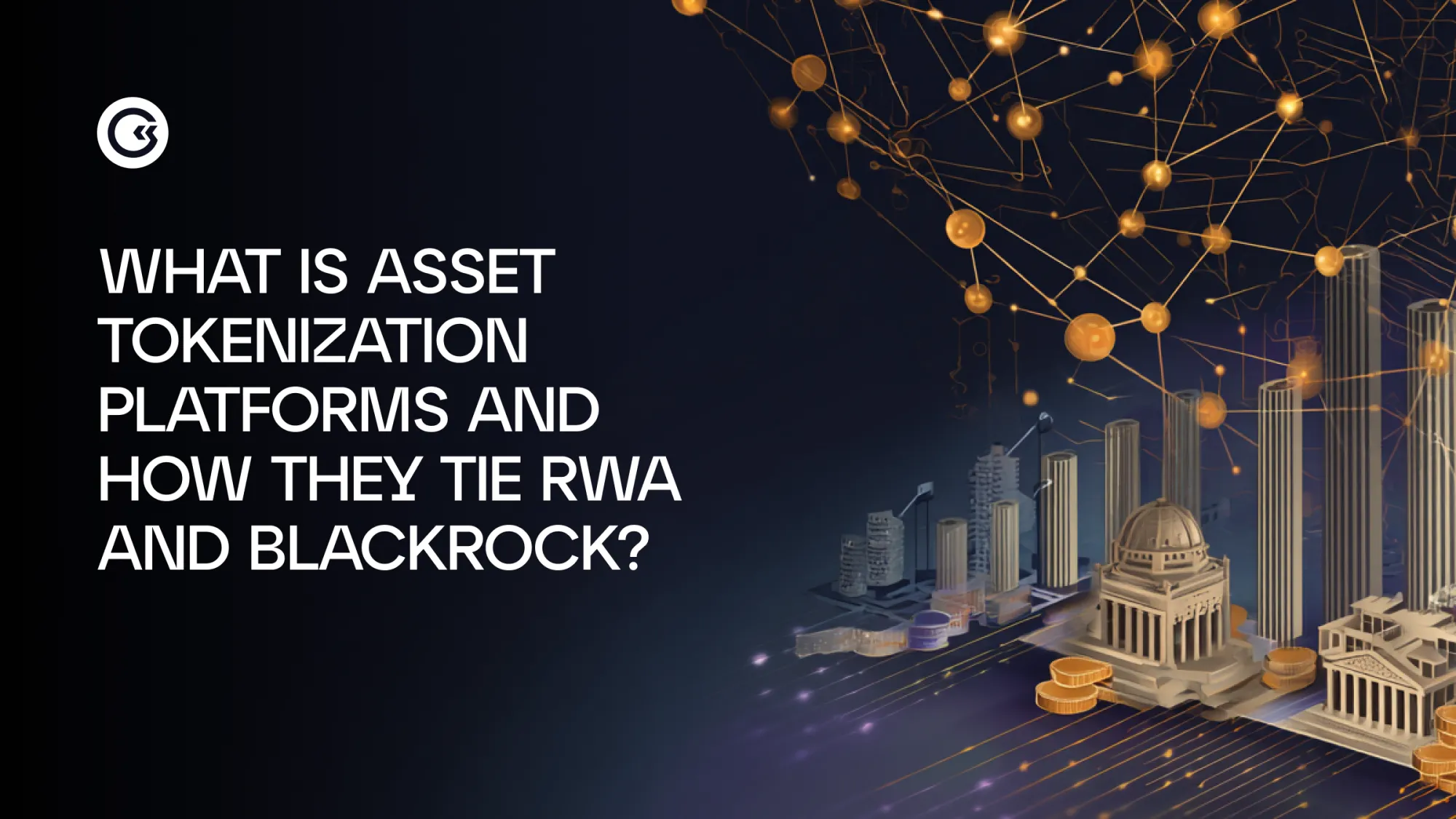
“The next generation for markets, the next generation for securities, will be tokenization of securities.”
This phrase was spoken by Larry Fink, and it carries particular weight when you understand the context. This is not a venture capitalist, not a crypto evangelist, and not a startup founder. This is the CEO of BlackRock — a company managing tens of trillions of dollars in assets.
Larry Fink
When someone with that level of responsibility says that the future of markets lies in tokenization, he is not speaking abstractly. He is describing an infrastructure shift comparable to the transition from paper stock certificates to electronic records held by depositories.
To understand why BlackRock is betting on RWA (Real World Assets), we first need to honestly answer a simple question: what is wrong with traditional finance today?
The Problem: Why Traditional Finance Slows Itself Down
Imagine making a bank transfer. The money is deducted immediately, but in reality it “arrives” a day or two later. In capital markets, this is called T+2 settlement — settlement two business days after the transaction.
For an individual, this is just an inconvenience. For the global financial system, it is a massive drag. While a transaction is “in transit”:
- capital is frozen and not productive;
- counterparty credit risks arise;
- clearing houses, intermediaries, and insurance mechanisms are required;
- operational costs increase.
Put simply, the financial market of the 21st century still operates like a postal service with paper receipts — just in digital form. This is not an exaggeration. The core architecture has barely changed for decades.
It is important to understand that the issue is not only speed. Traditional financial systems were historically built around trust in intermediaries, not around the efficient transfer of value. That is why settlement, clearing, and trade confirmation exist as separate layers — layers that emerged long before the internet.
But in a world where markets operate 24/7 and capital moves globally in seconds, this architecture starts to break down. Not because it is “bad,” but because it was designed for a different era — the era of paper, telephones, and closed trading sessions.
What Is an Asset Tokenization Platform, in Simple Terms
Asset tokenization is not “crypto instead of banks.” It is a software layer that connects the physical world with the blockchain.
Source: GoMining.com
If explained very simply, an asset tokenization platform is a translation machine between real-world assets and digital tokens.
Real estate, bonds, funds, gold, works of art — all of these can be represented as digital tokens, but only if three conditions are met:
- there is a legal link to the underlying real asset;
- regulatory requirements are met;
- the base asset is held in trusted custody.
This is exactly what tokenization platforms do.
A real-life analogy: Imagine a piece of candy. The asset itself is the filling (for example, a $10 million office building). The token is the wrapper. You do not eat the wrapper, but it is the wrapper that allows the candy to be sold, transferred, or exchanged instantly and safely.
Source: GoMining.com
Core Functions of Asset Tokenization Platforms
Legal Wrapper
A token is not just “a number on a blockchain.” It is legally tied to ownership rights, a fund share, or a debt obligation. Without this link, a token is just a souvenir.
Compliance and Regulation
KYC, AML, and sanctions screening are embedded at the smart contract level. If you do not pass verification, you simply cannot buy the token — automatically.
Custodial Storage
Physical assets or cash are held by trusted custodians — institutions like BNY Mellon or equivalent banks. The blockchain does not replace custody; it coordinates access to it.
The BlackRock Case: BUIDL and Securitize — Not an Experiment, but Infrastructure
BlackRock did not try to “build everything in-house.” Instead, it did what it does best: it chose the right partner.
Source: GoMining.com
That partner is Securitize, one of the most mature asset tokenization platforms on the market.
How the BUIDL Fund Works
The mechanism is surprisingly simple — and that is its strength.
An investor sends US dollars → Securitize issues BUIDL tokens → each token is stably pegged at $1 → yield is accrued daily, directly into the wallet, in the form of new tokens.
Under the hood are short-term US Treasury bills. No volatility. No speculation. No “yield magic.”
Source: GoMining.com
Why does this matter? Because this is the first large-scale case where US government bonds have been placed on a public blockchain — Ethereum — with 24/7 settlement.
The Technical Layers (Simplified)
To avoid drowning in terminology, let’s break this down into layers.
Layer 1 — The BlockchainThe ledger where truth lives: who owns what. Most often Ethereum, but Avalanche and Polygon are also used.
Layer 2 — The Smart ContractThe code that enforces the rules: who can buy, who can transfer, how yield is calculated.
Layer 3 — The PlatformThe interface where the user clicks “Buy” and sees their balance. This is where Securitize, Ondo Finance, and Centrifuge operate.
Layer 4 — OraclesThe bridge between reality and the blockchain. Oracles feed real-world prices and off-chain events into the system.
Source: GoMining.com
Why BlackRock Wants This: Trillion-Dollar Incentives
BlackRock does not make money on hype. It makes money on efficiency.
Instant Settlement
T+2 becomes T+0. Assets and cash move immediately. Capital is freed, and systemic risks are reduced.
New Collateral Utility
Tokenized assets can be used as collateral in other financial operations without being sold. This is a liquidity management revolution.
Automation
Wall Street running on code, not on paper and Excel. Fewer errors, fewer intermediaries, lower costs.
The Data That Shows the Scale
According to DeFiLlama, the total value of tokenized real-world assets on-chain has exceeded $17 billion and continues to grow.
Source: GoMining.com
Kaiko reports lower volatility in tokenized Treasuries compared to traditional stablecoins.
This is not an “alt season.” This is a change in foundations.
The fastest growth is seen in tokenized government bonds and money market funds — instruments traditionally considered “boring,” but reliable.
Nansen analysts note that wallets associated with institutional entities are increasingly active in RWA protocols, rather than retail traders. This is a crucial shift: blockchain is being used not for speculation, but for infrastructure efficiency.
How RWA Connects DeFi, ETFs, and Tokenomics
RWA acts as a bridge between:
- DeFi and traditional funds;
- ETFs and on-chain liquidity;
- PoS networks and real-world yield.
In essence, tokenization turns blockchain into a financial internet protocol, not just an environment for crypto assets.
Looking Ahead: 2026–2027
Over the next two years, we are likely to see:
- tokenized funds becoming available to retail investors;
- RWA integration into DeFi lending;
- the emergence of on-chain ETFs;
- a narrative shift from “Crypto vs. Banks” to “Banks running on crypto rails.”
What Industry Leaders Say About RWA and Tokenization
Support for real-world asset tokenization is growing far beyond BlackRock and the crypto industry itself. Jenny Johnson, CEO of Franklin Templeton, has emphasized that tokenized funds are not a speculative experiment but a structural improvement in how capital markets operate, pointing to faster settlement, lower operational costs, and improved transparency as the key drivers.
From the banking sector, Citi analysts frame tokenization as a multi-trillion-dollar opportunity rather than a niche crypto use case. In its Global Perspectives & Solutions report, Citi estimates that tokenized real-world assets — primarily bonds, funds, and real estate — could reach several trillion dollars in total value by the end of the decade, driven by institutional adoption and efficiency gains rather than retail speculation
A similar position is outlined by McKinsey & Company, which notes that asset tokenization has the potential to fundamentally change post-trade infrastructure by reducing settlement times from days to minutes and freeing up significant amounts of idle capital. According to McKinsey, the strongest near-term growth is expected in tokenized funds and fixed-income instruments, where regulatory clarity is already emerging.
Summary: The Point of Convergence
Tokenization of real-world assets is not a trend and not an experiment. It is an upgrade to the financial internet.
BlackRock is not “entering crypto.” It is moving the financial system onto new rails.
Follow GoMining Academy and get access to the crypto and Bitcoin course — it stays free while most of the market is still waiting for a “perfect entry”.
Telegram | Discord | Twitter (X) | Medium | Instagram
FAQ — Frequently Asked Questions
What is the difference between crypto and RWA?Crypto is digitally native. RWA is a digital representation of a real-world asset.
How risky is the BUIDL fund?It is backed by US Treasury bonds, among the safest instruments in the world.
Can retail investors participate?Access is currently limited, but regulatory frameworks are expanding rapidly.
Who holds the underlying assets in RWA structures?Real-world assets are held by regulated custodians such as major banks or licensed trust companies. The blockchain does not replace custody — it records ownership and coordinates access.
How does compliance work for tokenized assets?Compliance is enforced at the smart contract level through KYC/AML checks and wallet whitelisting. If an address is not approved, it cannot buy, hold, or transfer the token.
Which platforms tokenize assets?Securitize, Ondo Finance, Centrifuge, Polymath.
Will RWA replace banks?No. Banks will become part of the blockchain infrastructure.
Is there volatility?Minimal, especially for tokenized bonds.
Is this DeFi or TradFi?It is a hybrid — and that is its strength.
What comes after bonds?Real estate, private equity, and commodities.
January 24, 2026