For most of Bitcoin's history, miners have not actually chosen what goes into the blocks they mine. The pool chooses. A handful of pools, in fact, decide the contents of most Bitcoin blocks — the quiet centralisation the industry has lived with for over a decade.
Today, that assumption broke.
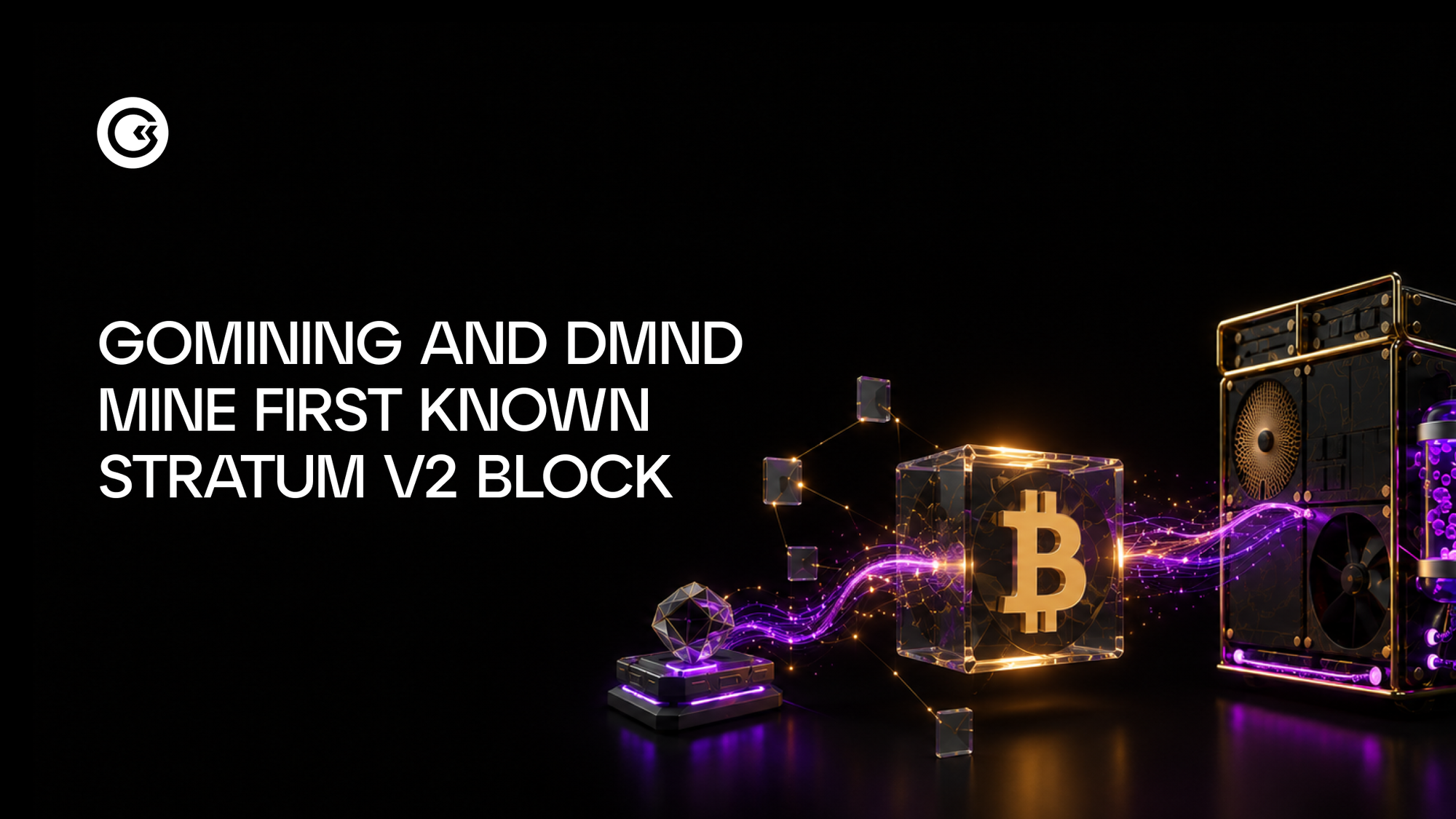
Working with the DMND mining pool, GoMining mined a Bitcoin block where the miner — not the pool — built and declared the block template, using Stratum V2's Job Declaration. We chose the transactions. We built the block. The pool got out of the way.
And the transactions we chose were not random. They were GoBTC Pay transactions.
Why Stratum V2 and GoBTC Pay belong together
Stratum V2 is an open-source mining protocol, years in the making, with contributors from across the Bitcoin industry. Its headline change is simple to say and hard to overstate: miners can build their own block templates while still mining in a pool.
That is not just a decentralisation win. It is the crucial piece for GoBTC Pay.
Because once a miner controls the block template, it can do something it never could before:
- Channel and prioritise GoBTC Pay transactions directly, from inside the pool, in the blocks we mine.
- Move GoBTC Pay payments toward fast, reliable settlement, without giving up the stability of pooled mining.
- Turn Stratum V2 from a promising idea into a working use case, which is exactly what helps the protocol get adopted across the sector.
In other words: Stratum V2 is the how. GoBTC Pay is the why. This is where the two come together in production — a real step in the GoBTC Pay rollout, powered by the most important mining upgrade in years.
A quick reminder: what GoBTC Pay is
GoBTC Pay is an open Bitcoin payments protocol built to do what the whitepaper described — Bitcoin used as money, with no compromises:
- On-chain. Payments settle on Bitcoin's base layer. No layer 2, no wrapped tokens, no IOUs. The block is the receipt.
- Non-custodial. Keys stay with the user. We cannot move your Bitcoin — only you can.
- Free for the users 0.2% for merchants split 50/50 between miners in the pool and wallets originated the transaction.
- Bitcoin-only. No stablecoins, no altcoins. Just Bitcoin, used the way it was meant to be.
- Open. Any wallet can integrate. It is rails, not a walled garden.
Mining the blocks ourselves is what makes those promises deliverable — and Stratum V2 is what lets us prioritise GoBTC Pay transactions making them cost-effective and settled within a 12 hour window.
In their words
"This block shows what becomes possible when miners control their own block templates. For years, pools decided which transactions made it into Bitcoin blocks. With Stratum V2 we can now prioritise the transactions that matter to us — and building this block around GoBTC Pay is a concrete step toward Bitcoin working as everyday money." — Mark Zalan, CEO, GoMining
"A handful of pools deciding what goes into Bitcoin blocks has always been the quiet centralisation point in the sector. At DMND we set out to put block creation back in the hands of miners — this is a genuine step in that direction, and we look forward to faster adoption of Stratum V2 across the sector." — Alejandro de la Torre, Co-founder & CEO, DMND
A note to the maximalists
If you have spent years explaining why proof-of-work matters and why pool centralisation is a real risk — this is for you. We are not expanding the use cases of anything. We are using a protocol the community has wanted for years to do the most Bitcoin thing possible: build our own blocks, and use them to move Bitcoin as money. Open, miner-controlled, on the base layer.
Where this goes
One block does not decentralise mining on its own, and it does not finish GoBTC Pay on its own — we are clear-eyed about that. What it does is prove the two work together outside a test environment: miner-controlled blocks, prioritising real payments, settling on the base layer. The more miners who build their own blocks, the healthier Bitcoin gets — and the closer GoBTC Pay gets to Bitcoin as everyday money. That is the direction. We intend to keep walking it.
Mine the blocks. Choose what goes in them. Make Bitcoin spendable.