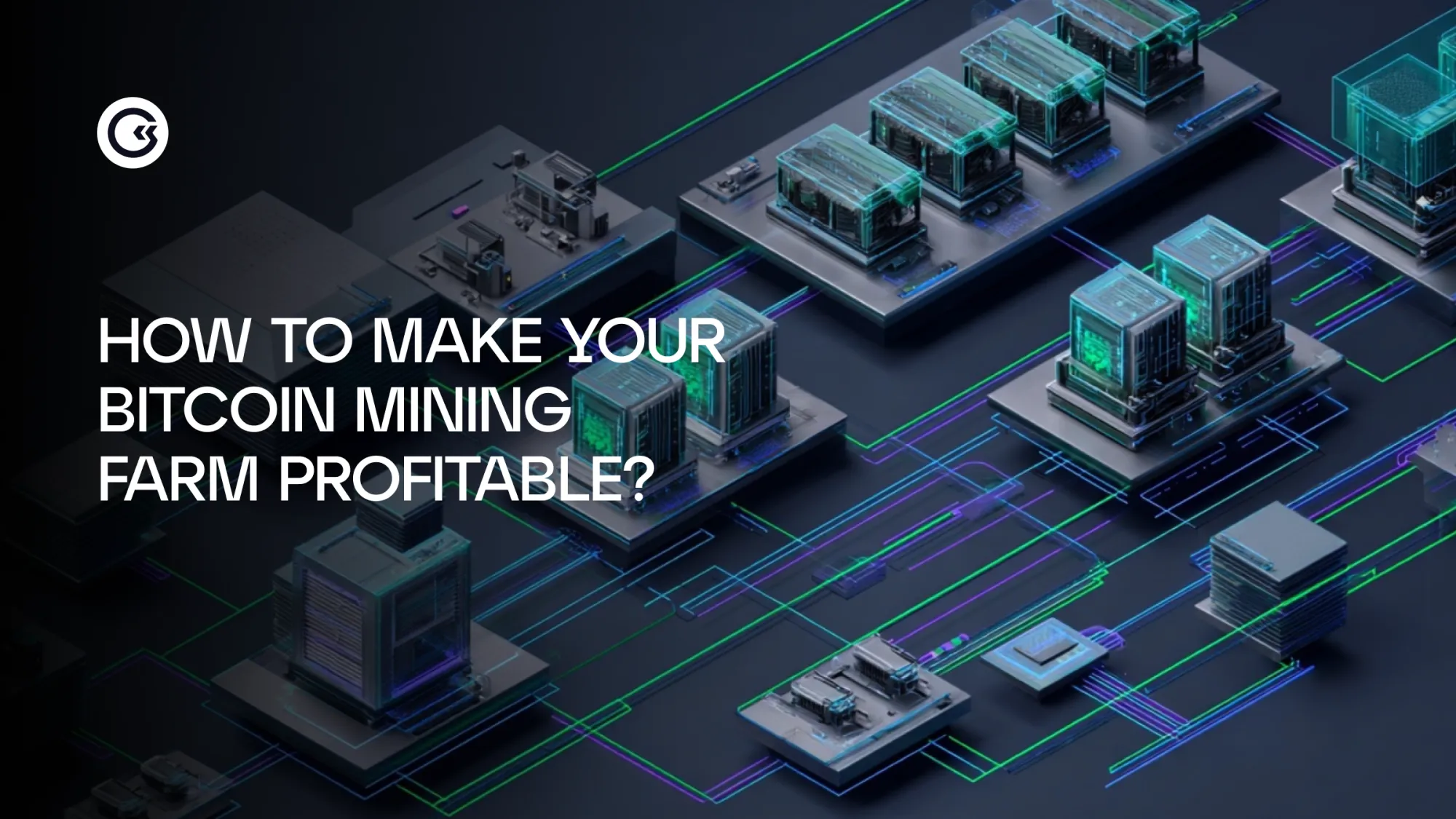
If a few years ago mining was associated with a noisy garage, GPUs, and hope for price growth, today it is a completely different business. Mining is now about infrastructure. Electricity. Cooling. Depreciation. Energy contracts. And strict math.
In this article, you will learn why most miners lose money even when Bitcoin goes up, what the survival formula looks like after the halving, and what you need to consider to avoid repeating the same mistakes in 2026.
Key Takeaways of Crypto Mining at Home?
- The key idea is simple: mining profitability depends far more on energy costs and hardware efficiency than on the BTC price.
- Mining no longer works on the principle of “buy it, turn it on, and wait for gains.” It is an industrial business where the winner is not the one who believes in price growth, but the one who calculates costs better.
- The goal of any mining farm is not to make money “right now,” but to survive the bear market and stay alive until the next bull cycle.
What the Real Cost of Mining Is Made Of
The mining formula looks like this:
Profit = (Bitcoin mined × BTC price) − (electricity + depreciation + maintenance).
If you break mining down into components, the picture is far less romantic than it looks on Twitter.
The largest share of costs — around 70% — goes to electricity. These are monthly bills that arrive regardless of the Bitcoin price.
Another ~20% is eaten by hardware depreciation. Miners wear out, become obsolete, and lose value faster than most people expect at the start.
The remaining 10% covers staff, rent, networking, and infrastructure maintenance.
This is why the Bitcoin price alone guarantees nothing. If electricity is expensive, a rising price only slows losses — it does not fix the problem.
With GoMining you don’t need to pay for hardware, electricity or infra maintenance, and get mining power directly from our farms.
Step 1. Electricity in Bitcoin Mining
Why a Rate Above $0.06 Is Almost a Death Sentence
The hard truth of mining is simple but brutal: if you pay residential electricity rates — around $0.12 per kWh or higher — your farm will almost inevitably run at a loss.
By 2026, network difficulty has increased, hardware has become more expensive, and the halving has already cut block rewards in half. There is no safety margin left. Even small miscalculations turn into losses.
That is why mining thrives where electricity is cheap and unstable for ordinary consumers—where it is easier to sell power to miners than to transmit it through the grid or use it locally.
Where Crypto Mining Happens in 2026
Texas has become one of the key Bitcoin mining hubs thanks to its grid-balancing model. Local farms act as controllable load: they turn on when there is excess energy and shut down during peak demand. This helps stabilize the ERCOT grid and lowers mining costs.

Wind turbines in Texas are being used to mine Bitcoin.
Paraguay produces massive amounts of electricity through hydropower, primarily from the Itaipu Dam. The country consumes far less electricity than it generates, which makes surplus power attractive for miners. Many farms are built near the dam or connected directly to the national grid.

Itaipu Dam
Ethiopia is another example of a country with low electricity costs and widespread hydropower usage. Large projects like the Grand Ethiopian Renaissance Dam (GERD) significantly increase grid capacity and allow access to cheap energy that some companies allocate to mining.

Grand Ethiopian Renaissance Dam (GERD)
What Is a PPA, in Simple Terms
A PPA (Power Purchase Agreement) is a long-term contract for electricity at a fixed price, usually signed for 3–5 years. For miners, it is a way to lock in the cost per kilowatt-hour and avoid tariff spikes that can quickly turn a profitable farm into a losing one.
Why Solar Mining Is Not About “Green Ideology”
Solar mining becomes profitable not because of environmental concerns, but for a much simpler reason. Once solar infrastructure is paid off, the effective cost of electricity can drop to $0.02 per kWh or even lower.
This is a rare case where upfront capital investments directly reduce ongoing operating costs and make mining economics more resilient over time.
Step 2. Bitcoin Mining Hardware
Why J/TH Matters More Than Hashrate
The most important hardware metric is joules per terahash (J/TH). It shows how much energy is spent per unit of computation.
According to Bitmain, the Antminer S19 has an efficiency of around 30 J/TH, while the newer S21 improves this to roughly 17.5 J/TH.
Lower J/TH means a machine stays competitive longer, even if its purchase price is higher.

Comparison of the energy efficiency of ASIC miners of different generations
When New Hardware Is Not the Best Choice
The newest models are expensive and lose value quickly. A machine that costs $5000 today can be worth $500 in three years (ASIC Miner Value — historical prices).
That is why experienced miners focus less on hype and more on reliable workhorse models with predictable ROI.
By 2026, GPU mining is used mainly for AI workloads and some altcoins. For the Bitcoin network, GPU mining is economically meaningless due to extremely low efficiency compared to ASICs.
Step 3. Cooling and Mining Infrastructure
Why Overheating Kills the Business
Overheating is one of the most underestimated reasons mining farms lose money. At first, everything seems fine — hashrate is there, machines are running — but electricity bills grow and devices reboot more often. After a year or two, farms face mass failures, lower performance, and accelerated depreciation.
Heat and dust are the main enemies. ASICs run 24/7 and generate enormous heat. If it is not removed efficiently, electronics operate under constant stress. Dust makes things worse by clogging heatsinks and increasing the risk of short circuits.
Air Cooling: Cheap but Limited
Air cooling is the simplest and cheapest way to build a farm. Fans push air through miners and expel heat outside. It works at the start, but it has limits.
At high equipment density, room temperature rises quickly. In hot or dusty regions, farms face constant overheating, noise, and higher failure rates. The hotter it gets, the more energy is spent on cooling — and the lower the final margin.
Immersion Cooling for Crypto Mining Farm
Immersion cooling solves this problem radically. Miners are fully submerged in a special dielectric fluid that efficiently removes heat from the chips. Fans become unnecessary, and temperatures stabilize.

Immersion cooling system for ASIC miners at an industrial farm
This setup requires higher upfront capital costs, but over time it delivers clear benefits: about 30% longer hardware lifespan, fewer failures, and lower cooling power consumption. For farms planning to operate for multiple cycles, this often makes economic sense.
Heat Recycling: The “European Approach”
In Europe, mining is increasingly viewed not only as a way to produce Bitcoin, but also as a heat source.

Using heat from mining to heat greenhouses
Farms connect to heating systems for warehouses, residential buildings, and greenhouses. What used to be a problem becomes a useful resource.
Step 4. Firmware and Software for Crypto Mining
Many miners lose money not because of bad hardware or expensive electricity, but because they never touch the settings. They turn the miner on and assume it works “as it should.” In practice, this almost always means losses.
Manufacturers configure hardware very conservatively so it runs stably under any conditions and with poor power quality. The price of that stability is wasted watts and excess heat.
Why Default Settings Are Hidden Losses in Mining Crypto
Custom firmware allows fine-grained control over how chips operate. The most common technique is lowering voltage without sacrificing stability. The miner does the same work but consumes less power and runs cooler.
In practice, this delivers a 10–15% efficiency boost without buying new hardware. When margins are thin, this can be the difference between profitability and slow death.
One of the best-known examples is Braiins OS+, which automatically tunes optimal parameters for each chip instead of relying on factory averages.

It is important to understand: firmware is not magic. It will not turn old hardware into new. But it helps extract the maximum from what you already have and delays the point where equipment becomes unprofitable.
Why Old Hardware Is Viable Option for Crypto Mining
Older models rarely “die” overnight. They gradually lose competitiveness. When electricity prices rise or network difficulty increases, these miners are the first to go negative.
Newer models last longer not because of marketing magic, but because of better energy efficiency.
This is the real competition in mining: whoever can operate longer under worse conditions survives.
Why Crypto Mining Farms Lose Money
The harshest factor is the halving. Every four years, block rewards drop by 50% overnight. If a farm barely breaks even before the halving, it will almost certainly become unprofitable after.
There are also regulatory risks. China showed that even large industries can be shut down by top-down decisions. Mining cannot be separated from politics and energy regulation.
The third factor is hardware depreciation. ASICs are consumables with a limited lifespan. Their market value drops dramatically over time. If investments are not recovered quickly, the math stops working.
Why Crypto Mining Is Primarily an Energy Business
“Bitcoin miners are the dung beetles of the energy world—they eat the wasted electricity nobody else wants.”
This quote perfectly captures the industry’s essence. Miners do not create energy and do not compete with households. They consume what would otherwise be wasted: excess generation, unstable sources, and power that cannot be efficiently transmitted.
Current Day Crypto Mining is arbitrage — buying cheap energy and converting it into a digital asset.
“Revenue is vanity, profit is sanity, but cash flow is reality.”
Impressive revenue numbers mean nothing without stable cash flow. A farm can show huge turnover and still lose money due to bad infrastructure or tariffs.
Outlook for Bitcoin Mining in 2026
Network difficulty will continue to rise as competition and hardware improve. Entry into mining will become even more capital-intensive.
Energy efficiency will become the final filter. Survival will be determined not by the Bitcoin price, but by the cost of electricity and the ability to manage it.
Mining will increasingly merge with energy infrastructure. It is no longer crypto speculation or “hardware in a garage,” but part of a broader system of energy production and distribution.
Conclusion
Bitcoin mining in 2026 is no longer about luck or market timing. It is a business with hard math, where electricity, hardware efficiency, and cost control decide everything.
Those who treat mining as energy infrastructure rather than speculation gain a long-term advantage. Cheap power, smart cooling, proper tuning, and risk awareness matter more than any price forecast. This approach allows farms to survive bear markets and be ready for the next bull cycle.
Follow GoMining Academy and get access to the crypto and Bitcoin course — it stays free while most of the market is still waiting for a “perfect entry”.
Telegram | Discord | Twitter (X) | Medium | Instagram
FAQ
Is Bitcoin mining legal? Yes. In most countries it is legal, but often subject to zoning, energy regulation, and taxation.
How much can expensive electricity hurt profitability? Above $0.06 per kWh, mining often becomes unprofitable even if Bitcoin’s price rises.
What matters more: Bitcoin price or energy cost? Energy cost. BTC price fluctuates, but tariffs and efficiency determine survival.
What is J/TH and why is it important? It shows energy consumption per unit of computation. Lower J/TH means longer competitiveness.
Does it make sense to buy the newest hardware? Not always. New models are expensive and depreciate fast. Reliable machines with clear ROI are often better.
Is GPU mining still viable for Bitcoin? No. Bitcoin mining is economically viable only with ASICs.
Do custom firmwares help? Yes. Solutions like Braiins OS+ can improve efficiency by 10–15%.
Why is cooling so important? Overheating accelerates wear, increases power bills, and causes downtime.
What does immersion cooling offer? Fewer failures, lower energy costs, and longer hardware life—at a higher upfront cost.
How does the halving affect mining? Every four years, revenue is cut in half. Farms that barely survive before will not survive after.
Can heat recycling be profitable? Yes. In Europe, mining heat is used to warm warehouses and greenhouses, reducing total costs.
Disclaimer
NFA, DYOR. The crypto market operates 24/7. This material is provided “as is” and does not constitute financial or investment advice.