Peer-to-peer electronic cash. On-chain. Non-custodial. Free for users. Bitcoin-only. Today, we ship it.
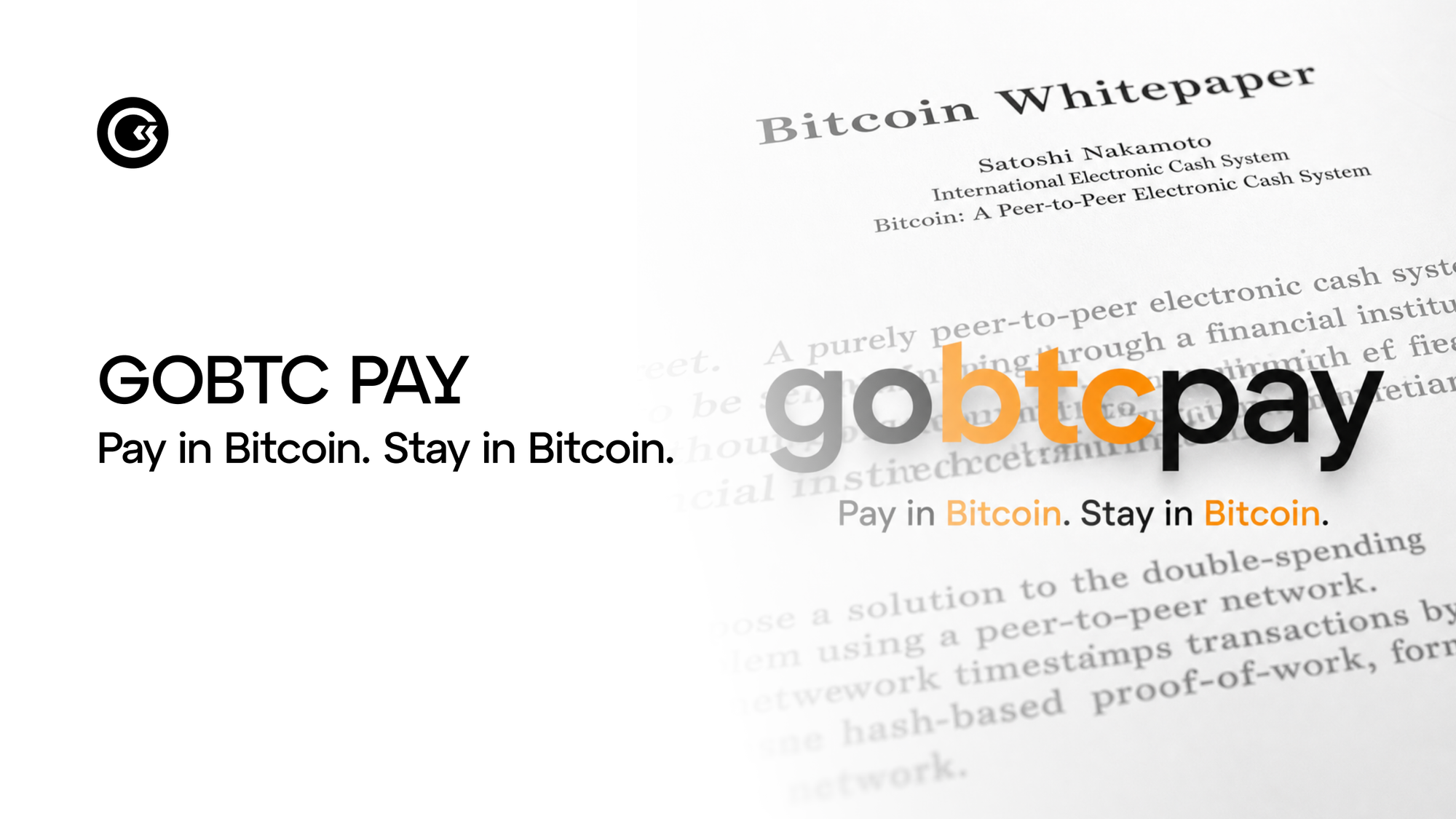
In October 2008, Satoshi opened the whitepaper with nine words that defined a movement:
“A purely peer-to-peer version of electronic cash…”
Eighteen years later, that sentence is still the unfinished business of Bitcoin.
We have the hardest money ever created. We have a $1.5+ trillion network. We have ETFs, treasuries, sovereign reserves, and an irreversible monetary thesis. What we still don’t have — what we have never quite had — is the ability for a person holding Bitcoin to walk into a shop, buy a coffee, and have it confirmed instantly and settled on the base layer, for free, without giving up their keys and managing nodes.
Today, that changes.
GoBTC Pay is live: https://gobtcpay.com/
What we built
GoBTC Pay is an open Bitcoin payment protocol that does exactly what the whitepaper described, with no compromises:
- On-chain. Every transaction settles on Bitcoin’s base layer. No layer 2. No sidechains. No wrapped anything. No IOUs. The block is the receipt.
- Non-custodial. A 2-of-3 multisig architecture: one key on your device, one with GoMining as co-signer, one with an independent regulated custodian. We cannot move your sats. Nobody can, except you.
- Free for the spender. Zero user fees. The cost of using your own money should be zero, and now it is.
- Bitcoin-only. No stablecoins. No altcoins. No tokens. No “crypto.” Just Bitcoin, the way it was meant to be used.
- No forced conversion. Merchants receive BTC. They keep BTC if they want to keep BTC. We will never auto-dump your customers’ sats into fiat to make a processor’s quarterly numbers look better.
- Open protocol. Any wallet — hardware, software, self-hosted — can integrate. Trust Wallet. Ledger. Sparrow. Whatever you run. GoBTC Pay is rails, not a walled garden.
Why this is finally possible
Every previous attempt to make Bitcoin spendable made one of three trades: it gave up non-custody, it gave up on-chain settlement, or it gave up on Bitcoin itself by converting to fiat at the till. Each compromise solved one problem by surrendering something more important.
GoBTC Pay refuses all three trades. We can refuse them because of one structural fact:
GoMining mines the blocks.
We operate 15 EH/s of Bitcoin mining capacity across data centres in the US and globally, and plan to add 1 GW mining capacity by the end of the year. When a GoBTC Pay transaction is broadcast, it is included in the next block produced by GoMining’s private pool. Yes, we are creating our private mining pool to support the protocol and aim for a 12-hour on-chain settlement by the end of 2026. No payment company on Earth can offer that, because no payment company on Earth is also a top-ten miner.
This is what turns “instant, free, on-chain, non-custodial” from a fantasy into a product.
The fee model is the message
A retail BTC payment on GoBTC Pay costs the user 0% and the merchant 0.2%.
That 0.2% does not sit on a balance sheet in San Francisco. It is split in half and sent right back into the network that produced the transaction:
- 0.1% to the miners in GoMining’s pool, pro-rata. Hashrate gets paid for doing what hashrate is supposed to do — confirm transactions.
- 0.1% to the wallet whose user initiated the payment. Build a wallet that supports GoBTC Pay, and every payment your users make pays you. We keep nothing from third-party flow. Nothing.
Card networks take 1.5% to 3.5% on a $100 sale. BitPay takes 1%. We take a fifth of a percent and route every basis point of it back to the people running the network. That is not a marketing claim. That is the protocol.
A note to the maximalists
We are not here to “expand the use cases of crypto.” We are here to finish what was started in a PDF on a cypherpunk mailing list in 2008.
If you have spent fifteen years explaining to your relatives why Bitcoin is different, why proof-of-work matters, why non-custody is non-negotiable, why a stablecoin is just a tradfi liability with extra steps — this protocol is for you. It was designed by people who agree with you, on rails owned by people who agree with you, and it is open so that the next ten thousand wallets and merchants can join.
Bitcoin should be money. Today, with GoBTC Pay protocol launch, it can be.
What ships today, and what comes next
Today, GoMining’s 5 million users get a non-custodial GoBTC Pay wallet and the ability to send and receive BTC on the GoBTC Pay rail. Later this quarter, the merchant side of the network goes live: point-of-sale terminals, merchant dashboards, an open developer SDK, and plugins. Through the back half of 2026 we expand to person-to-person payments, fiat off-ramps where merchants want them, and a widening network of connected wallets and institutions.
By 2027, the goal is simple: any Bitcoin holder, anywhere, on any wallet, paying any merchant — on-chain, non-custodially, for free. Open protocol. Mining-powered settlement. Bitcoin as money, at planetary scale.
That is the road. We are walking it from today.
Stack sats. Spend sats. Keep your keys.
If you run a wallet, integrate the protocol. If you run a merchant, accept BTC at 0.2% and keep your sats. If you hold Bitcoin, install the wallet and go spend a few sats on something stupid, just because, finally, you can.
Bitcoin was always meant to be cash. Welcome to the part where it is.
GoBTC Pay launches today at Consensus Miami 2026.